We hear about reforestation almost every day, but there is often confusion about what it really means. In an era marked by global deforestation and the climate crisis, rebuilding forest cover is an absolute priority. Reforesting, however, does not simply mean “planting trees in the ground”: it is a complex scientific process that aims to bring life back to degraded ecosystems. In this article we will clarify the differences between the various interventions and see how the scientific management of the territory can generate real benefits for the environment and society.
What is reforestation and how it differs from other forestry interventions
To understand the importance of these interventions, we first need to define the field of action precisely. Although they are often used as synonyms, reforestation and afforestation indicate profoundly different actions.
- Reforestation (or restocking) is the action of re-establishing a forest on land that was previously wooded but has lost its cover because of traumatic events such as fires, disease or direct human intervention (deforestation).
- Afforestation consists instead of creating a new forest in areas that, historically, have never been wooded or have not been for a very long time (at least 50 years), such as former agricultural land.
Understanding these distinctions is essential because the climate crisis and uncontrolled urbanisation require different project approaches. A successful project cannot be left to chance: it must be based on a scientific vision that identifies the causes of degradation (fires, intensive agriculture or overgrazing) in order to intervene with the most effective method.


Why reforestation is important
What benefit does the Earth gain from reforestation? The answer lies in ecosystem services, that is, the advantages that nature offers us people. We often think of these services as something intangible, but they are as tangible as the wood we use to build or the mushrooms we gather in the undergrowth. We can group them into four fundamental areas:
- Supporting services: the functions that underpin everything, such as photosynthesis, nutrient cycling and soil formation. Here, reforestation is crucial for protecting biodiversity and restoring degraded ecosystems, creating habitats for a myriad of species.
- Provisioning services: the physical goods we obtain from the forest, such as food (fruit, mushrooms), drinking water and timber, a renewable raw material essential for the ecological transition.
- Regulating services: here we find the role in tackling climate change through CO2 absorption and carbon sequestration. But not only that: reforestation ensures improved air and water quality, prevention of soil erosion and natural protection from landslides and avalanches.
- Cultural services: forests offer aesthetic, spiritual and recreational values. Think of the physical and mental benefits of a walk in the forest or the educational value of a restored ecosystem.
Good management of ecosystems is our responsibility: forest ecosystem services are expressed both through a nature reserve and through sustainable timber management.
How a reforestation project works
Each of our reforestation projects does not end when we plant the trees. We follow a scientific method, acting in three fundamental phases to ensure that the intervention turns, over time, into a stable and resilient ecosystem.
- Site study and design: every intervention begins with an in-depth analysis of the context. In this phase we decide which species to plant, always favouring native plants, that is, those originating from the territory, and avoiding non-native (exotic) ones that could prove invasive. We study the soil type and the needs of the place: we often work in degraded areas, such as mountain slopes hit by extreme events, where reforestation is essential to speed up soil recovery and prevent hydrogeological instability.
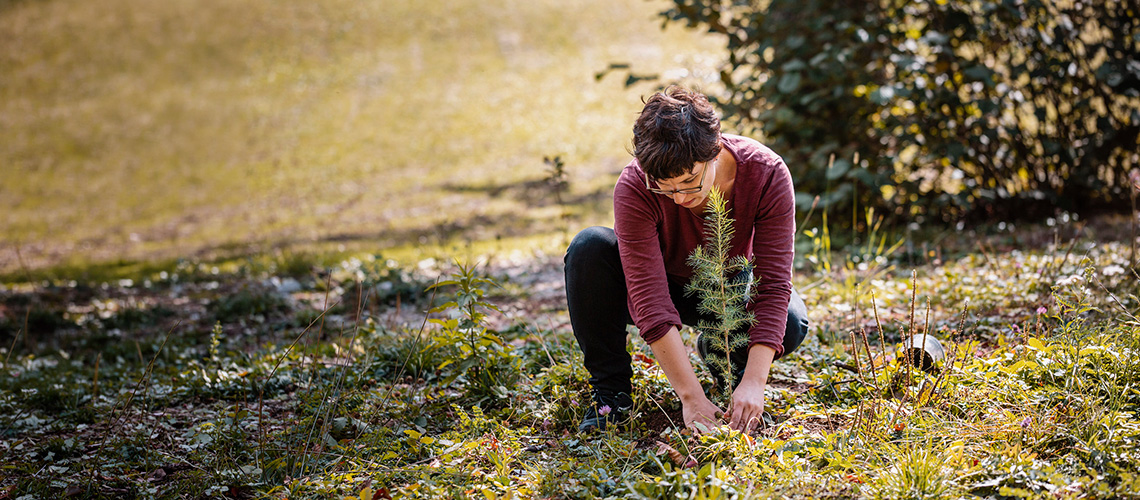
- Planting phase: once the project is defined, we move to action in the field. Planting is carried out using techniques that respect natural dynamics, ensuring that each young tree has the space and conditions it needs to take root.
- Maintenance and monitoring: the work does not end when the tree is in the ground. The project is constantly monitored to ensure the growth of the new forest and to intervene with mowing and irrigation when necessary.
Reforestation examples and case studies
In 2025 we completed a large project involving numerous stakeholders. The Bioclima initiative aimed to improve the biodiversity and climate resilience of Lombardy’s forests. Thanks to a co-financing model involving more than 100 companies, tangible results were achieved:
- 12 forest projects developed in the natural parks of Lombardy;
- 66,000 trees planted across new plantations, hedges and tree lines;
- 300 hectares of existing forests improved and monitored;
- 1,500 people directly involved in events to discover and enhance the territory.
These figures show that, when science meets private commitment, it is possible to generate a measurable impact on the territory’s capacity to absorb CO2 and protect biodiversity.

How to take part and make a difference
Regenerating nature is a collective challenge that requires the commitment of people, organisations and companies. Citizens can take concrete and transparent action by choosing to adopt a tree directly on our website, where you can select the species to plant and the specific project to support. This gesture contributes to the reforestation of critical areas, from the mountains to prevent hydrogeological instability to the city to counter heat islands.
Likewise, companies can invest in certified projects to grow their own corporate forest, thus integrating the protection of natural capital into their sustainability and CSR strategies. Taking part in these initiatives means taking responsibility for managing the territory, ensuring that every tree becomes part of a healthy, resilient and lasting ecosystem.